

Ethical Hacker Roadmap (2026): How to Become an Ethical Hacker from Scratch
Master the 2026 ethical hacker roadmap. From zero to hero: learn Linux, Python, certifications (CEH, OSCP), and land a high-paying cybersecurity job.

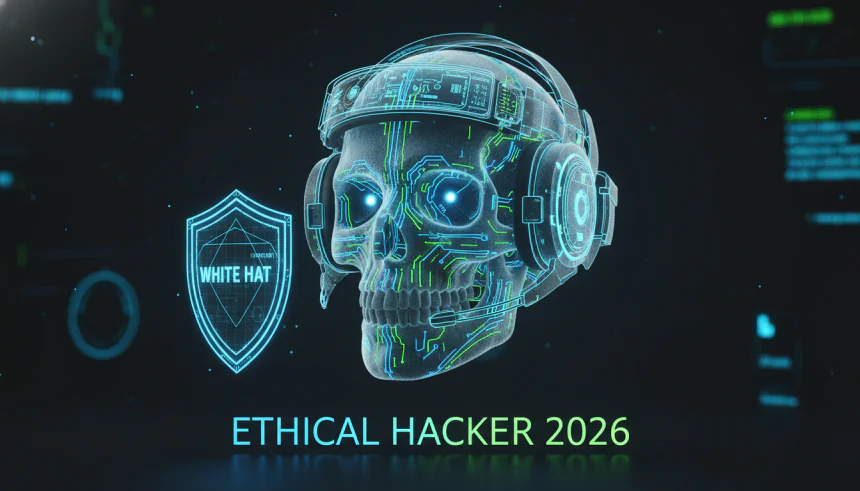
The Ultimate Ethical Hacker Roadmap: How to Become an Ethical Hacker from Scratch (2026)
So, you want to break things to make them safer? You’re in the right place. The world of cybersecurity is changing fast, and the path that worked five years ago won’t cut it today. This ethical hacker roadmap is designed to take you from a complete beginner to a job-ready professional in 2026.
Forget the movies. Real hacking isn't about green code falling down a screen while you type 100 words per minute. It’s about persistence, problem-solving, and understanding systems better than the people who built them.
"I still remember the thrill of my first 'Eureka' moment. It wasn't about causing damage; it was about solving a puzzle that everyone else said was impossible. I chose this field because I realized that in a digital world, safety isn't a given—it's engineered. Being the person who ensures that safety felt like a superpower."
Table of Contents
- Introduction: Why Become an Ethical Hacker in 2026?
- The Talent Gap is Real
- Show Me the Money
- White Hat vs. Black Hat
- Phase 1: The Foundation (Don't Skip This!)
- Computer Fundamentals & Virtualization
- Networking Basics: The Plumbing of the Internet
- Operating Systems: Why Linux is King
- Phase 2: Programming and Scripting Skills
- Python: The Swiss Army Knife
- Bash Scripting
- Web Technologies (HTML/JS/SQL)
- Phase 3: The Ethical Hacker's Toolkit
- Operating System: Kali Linux or Parrot OS
- Must-Know Tools Breakdown
- Phase 4: Hands-On Practice & CTFs
- Gamified Learning Platforms
- CTF Competitions
- Phase 5: Certifications – The 2026 Standard
- The Certification Hierarchy
- Phase 6: Specialization and Career Trends (2026)
- Cloud Security (AWS/Azure)
- AI and Machine Learning Red Teaming
- Bug Bounty Hunting
- How to Land Your First Job
- Build a Portfolio
- Networking (The Human Kind)
- The Interview
- FAQs about the Ethical Hacker Roadmap
- How long does it take to become an ethical hacker?
- Is CEH still worth it in 2026?
- Can I learn ethical hacking on my own?
- Conclusion
Introduction: Why Become an Ethical Hacker in 2026?
The stakes have never been higher. With the rise of AI-driven attacks and cloud infrastructure, companies are scrambling to find people who can think like attackers but follow the rules.
The Talent Gap is Real
You keep hearing about layoffs in tech, but cybersecurity tells a different story. There are roughly 3.5 million unfilled jobs globally. Companies aren't just looking for bodies; they are looking for skilled professionals who can stop a breach before it happens.
Show Me the Money
Let's talk numbers. This is a lucrative field, but it requires skill.
- Junior Pentester: $70,000 - $100,000 (US Average)
- Senior Security Consultant: $120,000 - $180,000+
- Bug Bounty Hunter: Variable (Top hunters make millions, beginners make coffee money).
White Hat vs. Black Hat
It all comes down to permission. A "Black Hat" hacks for gain or malice. A "White Hat" hacks to secure. The skills are identical. The tools are the same. The difference is a piece of paper—a signed contract authorizing you to test the system.
"Think of the famous 2017 Equifax breach. Hackers stole data from 147 million people because of a simple unpatched vulnerability. That’s Black Hat work. Now, compare that to the 19-year-old on HackerOne who found a similar bug in a major airline's system, reported it, and earned a $15,000 bounty legally. Same skill, totally different outcome."
Phase 1: The Foundation (Don't Skip This!)

If you try to hack a system without understanding how it works, you are just a "script kiddie." You’re running tools you don’t understand. To be a pro, you need to know what happens under the hood.
Computer Fundamentals & Virtualization
You cannot hack on your main computer. You need a safe space. This is where virtualization comes in.
You need to get comfortable with VirtualBox or VMware. You will be building a "Lab"—a virtual network of computers inside your own computer. If you break one, you just reset it. No harm done.
Networking Basics: The Plumbing of the Internet
Hacking is mostly networking. If you don't know how data moves from Point A to Point B, you can't intercept it. You need to master these concepts:
- The OSI Model: Don't just memorize the 7 layers. Understand that physical cables are Layer 1, and your web browser is Layer 7.
- TCP/IP: The handshake protocols. How computers say "hello" and establish a connection.
- IP Addressing & Subnetting: IPv4 vs IPv6. How to identify a target on a network.
- DNS: How
google.comturns into an IP address. DNS poisoning is a classic attack vector. - Ports and Protocols: Know your standard ports (80 for HTTP, 443 for HTTPS, 22 for SSH, 21 for FTP).
"Honestly, Subnetting gave me nightmares at first. Calculating binary masks felt like tedious math class all over again. But the moment I understood how ARP (Address Resolution Protocol) works—how your computer screams 'Who has this IP?' into the void—it clicked. Suddenly, I could visualize the traffic flowing like water in a pipe."
Operating Systems: Why Linux is King
Windows is great for gaming. Linux is for hacking. Most servers run on Linux, and most hacking tools are built for Linux. You need to stop clicking icons and start typing commands.
Master the Terminal (Bash):
ls,cd,pwd(Navigation)grep,awk,sed(Text manipulation)chmod,chown(Permissions - vital for escalation)ps,top,kill(Process management)
Phase 2: Programming and Scripting Skills

Do you need to be a developer to be a hacker? No. Do you need to understand code? Absolutely. You aren't building apps; you are breaking them. You need to read code to find the mistake the developer made.
Python: The Swiss Army Knife
Python is the most important language for an ethical hacker roadmap. It's easy to read and has massive libraries for security. You will use Python to:
- Write custom scripts to automate attacks.
- Parse huge log files.
- Create brute-force tools.
Bash Scripting
Since you are using Linux, you need to automate your OS tasks. A simple Bash script can save you hours of typing.
Web Technologies (HTML/JS/SQL)
The web is the biggest attack surface. To hack a website, you need to speak its language.
- HTML/CSS: Understand the structure.
- JavaScript: Crucial for Cross-Site Scripting (XSS) attacks. client-side logic happens here.
- SQL: The language of databases. SQL Injection is still one of the most dangerous vulnerabilities out there.
"If I had to pick just one language to start with, it would be Python. It reads like English. You can write a port scanner in 10 lines of Python code that would take 50 lines in C++. It lowers the barrier to entry so you can focus on the logic, not the syntax errors."
Phase 3: The Ethical Hacker's Toolkit

Tools don't make the hacker, but they certainly help. In 2026, the toolset has evolved, but the classics remain.
Operating System: Kali Linux or Parrot OS
Kali Linux is the industry standard. It comes pre-loaded with thousands of tools. Parrot OS is a lighter alternative that is gaining popularity. Pick one and stick to it.
Must-Know Tools Breakdown
| Tool Name | Category | What it Does |
|---|---|---|
| Nmap | Scanning | The map maker. Scans networks to find live hosts and open ports. |
| Wireshark | Sniffing | Captures packets flowing through the wire. Essential for analysis. |
| Burp Suite | Web Proxy | Intercepts traffic between your browser and a server. The #1 tool for web hacking. |
| Metasploit | Exploitation | A massive framework to launch exploits against targets. |
| Hashcat | Cracking | The fastest password cracker. Uses your GPU to break hashes. |
"I remember scanning a practice target with Nmap and seeing port 21 (FTP) open. I thought it was a trap. It turned out the 'admin' had left 'anonymous' login enabled. I walked right into the server without a password. It taught me a valuable lesson: the biggest vulnerabilities are often simple misconfigurations, not complex zero-day exploits."
Phase 4: Hands-On Practice & CTFs

You cannot learn hacking from a book. You have to get your hands dirty. But you can't hack real websites (that's illegal, remember?). This is where CTFs (Capture The Flag) come in.
Gamified Learning Platforms
TryHackMe: Start here. It holds your hand. They have "rooms" that guide you through specific concepts with tutorials and virtual machines right in the browser.
Hack The Box (HTB): This is the training ground. Once you finish the easy stuff on TryHackMe, go here. HTB gives you a target IP and says "Good luck." It mimics real-world scenarios perfectly.
CTF Competitions
Participate in events like PicoCTF. It builds team skills and teaches you to work under pressure. Plus, solving a hard challenge gives you a rush unlike anything else.
Phase 5: Certifications – The 2026 Standard

Certifications get you past the HR filter. They prove you know the theory and, more importantly, can do the job.
The Certification Hierarchy
| Level | Certification | Why Get It? |
|---|---|---|
| Entry | CompTIA Security+ | Teaches the vocabulary. Required for many government jobs. |
| Junior Practical | eJPT (eLearnSecurity) | Actual hands-on exam. Much better than multiple choice. |
| HR Favorite | CEH v13 (Certified Ethical Hacker) | Expensive and mostly theory, but HR managers love it. Now covers AI tools. |
| The Gold Standard | OSCP (Offensive Security) | The legendary 24-hour exam. If you have this, you are a confirmed hacker. |
"When studying for the eJPT, I made a mistake: I focused too much on memorizing flags. In the real exam, I froze. The best tip I can give is to build your own 'Cheatsheet.' Don't just read commands; type them out and write down what they do in your own words. During a stressful exam, that notebook is your best friend."
Phase 6: Specialization and Career Trends (2026)

Once you know the basics, you need to specialize. Being a "generalist" is fine, but specialists get paid the big bucks. Here is what is hot in 2026.
Cloud Security (AWS/Azure)
Everything is in the cloud. Companies are moving from on-premise servers to AWS buckets. Misconfigured cloud settings are the #1 cause of data breaches today. Learning how to pentest cloud environments is a super-power.
AI and Machine Learning Red Teaming
This is the new frontier. Companies are integrating ChatGPT and LLMs into their products. "Prompt Injection" is the new SQL Injection. Learning how to trick AI models into revealing secrets is a massive emerging field.
Bug Bounty Hunting
Platforms like HackerOne and Bugcrowd allow you to hack massive companies (like Uber, Tesla, or Google) legally. If you find a bug, they pay you. It’s hard work, but it builds an incredible portfolio.
"The rise of AI has terrified some, but for us, it's a goldmine. I'm seeing a massive shift where companies aren't just asking 'Is our server secure?' but 'Can your prompt injection trick our AI chatbot into revealing customer credit cards?' The battlefield is moving from the firewall to the algorithm."
How to Land Your First Job
You have the skills. You have a cert. How do you get hired?
Build a Portfolio
A resume isn't enough. Create a GitHub repository with your Python scripts. Write a blog detailing how you solved a specific Hack The Box machine (don't post spoilers for active machines, though!). Documentation shows you can communicate.
Networking (The Human Kind)
Join Discord servers. Connect with people on LinkedIn. The InfoSec community is tight-knit. Many jobs are filled through referrals before they are ever posted online.
The Interview
Expect technical questions. They might ask, "What happens when you type google.com into a browser?" or "How would you secure a Linux server?" Be honest. If you don't know, say "I don't know, but here is how I would find the answer."
FAQs about the Ethical Hacker Roadmap
How long does it take to become an ethical hacker?
If you start from zero, expect to spend 6 to 12 months of dedicated study to be ready for an entry-level role. It’s a marathon, not a sprint.
Is CEH still worth it in 2026?
Yes, but mostly for getting past the resume screeners. For actual skills, focus on OSCP or CPTS (Certified Penetration Testing Specialist).
Can I learn ethical hacking on my own?
100%. The best hackers in the world are self-taught. All the resources you need are online, often for free.
Conclusion
Following this ethical hacker roadmap requires discipline. There will be days when you feel stupid. There will be scripts that refuse to run and exploits that fail. That is part of the job.
The only difference between a master hacker and a beginner is that the master has failed more times than the beginner has even tried. Start your VM, open the terminal, and start learning today.
"Remember, every expert hacker you admire was once exactly where you are now—staring at a blinking cursor, confused and frustrated. The only way to fail is to stop typing. Good luck, and happy hacking!"
Share
What's Your Reaction?
 Like
0
Like
0
 Dislike
0
Dislike
0
 Love
0
Love
0
 Funny
0
Funny
0
 Angry
0
Angry
0
 Sad
0
Sad
0
 Wow
0
Wow
0



![Power BI vs. Tableau: Which One Should You Learn in 2026? [Full Comparison]](https://eallinfo.com/uploads/images/202601/img_w140_6965d797a05da0-22156126.webp)




![Power BI vs. Tableau: Which One Should You Learn in 2026? [Full Comparison]](https://eallinfo.com/uploads/images/202601/img_w500_6965d796ef18b6-82011059.webp)
